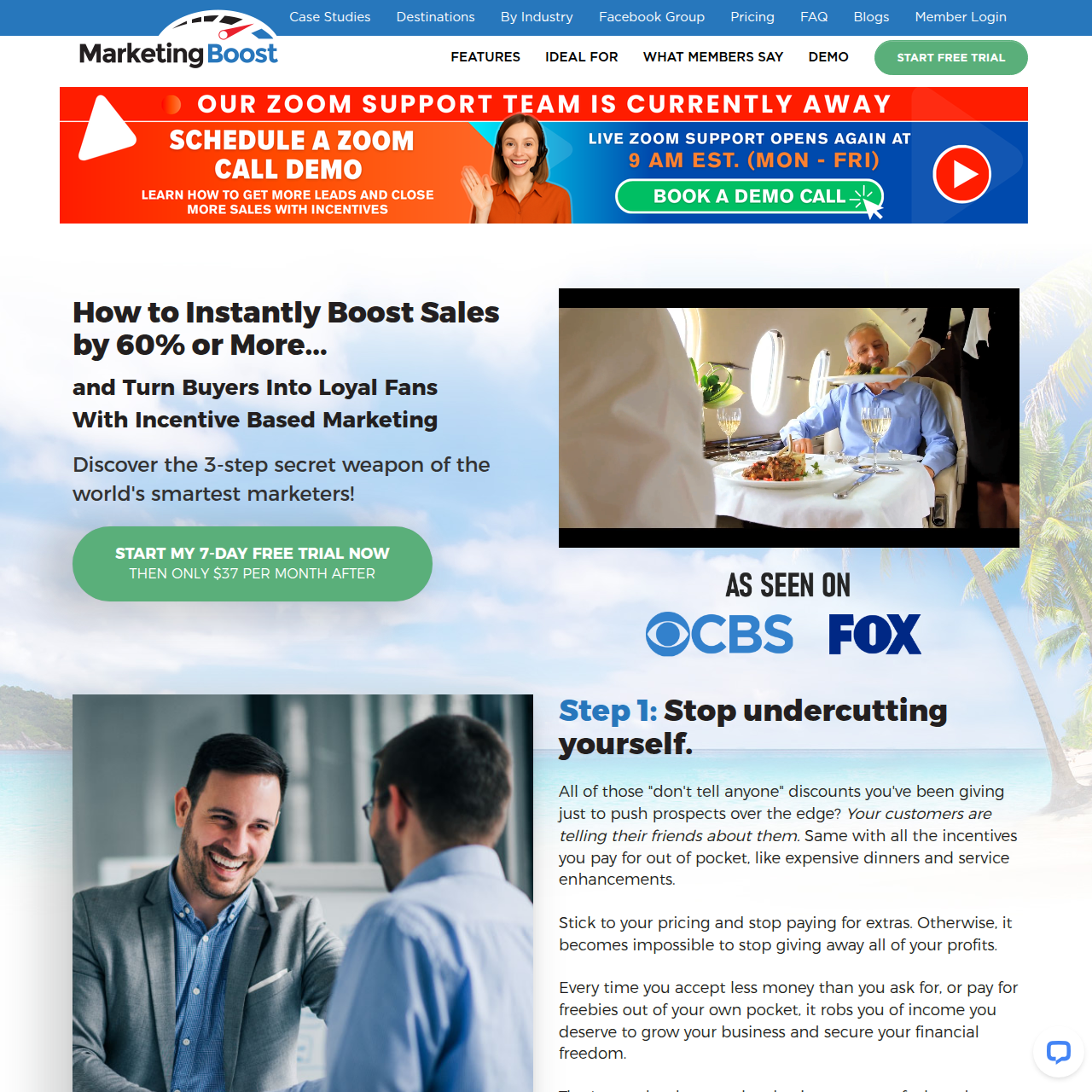
If you've been quietly handing out discounts just to close deals, this MarketingBoost review is going to hit close to home. I've been using the platform for a while now, and after adding over 200 new travel program members using their free vacation incentives, I have some real opinions about whether it's worth your $37 a month.
Here's the thing about discounting: it feels like a sales strategy, but it's actually a slow leak in your revenue bucket. Every time you shave 20% off your offer to push a fence-sitter over the edge, you're training your market to wait for the discount. And your customers talk. They tell their friends what they actually paid. Now your pricing means nothing.
MarketingBoost is built around a different idea entirely. Instead of cutting your price, you keep your price and add a high-value travel incentive, like a free vacation, that you don't personally have to fund or fulfill. The prospect gets something tangible and exciting. You keep your margin. And MarketingBoost handles the vacation side of things behind the scenes.
I want to be honest with you about what this platform actually is, how it works in practice, and who it makes sense for. So let's get into it.
What is MarketingBoost and how does it actually work?
MarketingBoost is a subscription-based incentive platform. For $37 per month, you get access to a library of vacation certificates that you can give away to your customers, clients, or prospects as bonuses when they buy from you, refer someone, or hit a milestone you set.
The mechanics are straightforward. Once someone buys your offer, you give them a certificate. They have 7 days to activate it. Once activated, the certificate is valid for 18 months, and they can book and travel any time within that window. The destinations are real, the trips are real, and MarketingBoost handles the fulfillment. You're not booking anything. You're not paying for flights or hotels out of pocket. You're just handing someone a certificate and letting the platform do the rest.
Over 10,000 business owners have used the platform to give away more than 500,000 vacations. That's not a small pilot program. That's a functioning machine.
Start your free 7-day trial of MarketingBoost here
Is MarketingBoost worth it for small business owners?
The $37 per month price point is almost suspiciously low given what you're offering your customers. A single vacation certificate, if your client actually took that trip, could represent thousands of dollars in perceived value. And the research backs up why this works so well psychologically.
Oxford Economics put out a study showing that people are 3 times more motivated to take action when offered tangible incentives like travel compared to cash incentives like discounts. The explanation is simple: people can picture a vacation. They can imagine sitting on a beach or walking through a city they've never seen. A 15% discount is just a number. It doesn't create a mental image.
In my own experience, I've added over 200 new travel program members by pairing my offers with MarketingBoost vacation certificates. That's a real number from my actual business, not a hypothetical. The conversion difference was noticeable, and I wasn't lowering my prices to get there.
That said, "worth it" depends heavily on your offer. If you're selling something for $27 and your margins are thin, vacation incentives probably won't move the needle enough to justify even $37 a month. But if you're selling coaching packages, consulting retainers, high-ticket services, or anything where a few extra conversions per month represent meaningful revenue, the math works out pretty fast.
Who is MarketingBoost designed for?
The platform lists business owners, sales managers, marketing managers, affiliate marketers, and network marketers as their core audience. That tracks with what I've seen inside the member community.
The use cases that make the most sense are:
- Coaches and consultants who want to close high-ticket packages without discounting
- Affiliate marketers adding bonus stacks to their offers
- Network marketers using travel incentives to drive referrals
- Service businesses using vacations as loyalty rewards for repeat clients
- Sales teams looking for a closing tool that doesn't eat into commission
One case study on the platform shows someone closing a $12,000 coaching package using a vacation giveaway as the deciding factor. That's the kind of scenario where MarketingBoost pays for itself in a single transaction. The platform claims members have collectively generated over $375,000,000 in sales influenced by these incentives. I can't verify that number independently, but the volume of vacations distributed, over 500,000, suggests the activity is real.
The platform is NOT right for businesses with very low-ticket offers or tight margins. Vacation incentives work best when the offer itself has enough perceived value that a bonus trip feels proportionate, not gimmicky.
What destinations and trips does MarketingBoost actually offer?
This is usually the first question skeptics ask, and it's a fair one. The certificates cover real destinations, including beach resorts, Las Vegas, Mexico, and other travel categories that people actually want. The platform has a destinations section where you can browse what's available before committing.
The certificates are not "fly yourself there and we'll cover the hotel for a Tuesday in January" situations. They're designed to feel like genuine rewards, which is the whole point. If the vacation felt cheap, it would undermine your brand rather than enhance it.
Certificate holders get 18 months of flexibility to book once they activate, which reduces the "I'll never actually use this" objection that kills a lot of bonus offers. People can plan around their schedule instead of feeling pressured into a specific window.
How does MarketingBoost compare to just offering a cash discount?
Discounts are permanent damage. Once you drop your price for one customer, that becomes the reference point for everyone they talk to. And they will talk. The MarketingBoost sales page makes this point directly, and honestly, it's the most important strategic argument for the platform.
A vacation certificate, by contrast, has a perceived value that's higher than its cost to you. That's the asymmetry that makes it work. Your customer feels like they're getting something extraordinary. You're paying $37 a month to access certificates that create that feeling at scale. A cash discount gives your customer money. A vacation gives them a story.
The Oxford Economics data on tangible vs. cash incentives reinforces this. People remember experiences. They don't remember that they saved $200 on a service package six months ago. But they remember the trip to Cancun they took because they signed up with you.
See how MarketingBoost vacation certificates work in practice
What's inside the MarketingBoost member area?
Beyond the certificates themselves, the member area includes case studies organized by industry, a Facebook group where members share what's working, and destination browsing so you can see exactly what you're offering before you pitch it to a prospect.
The case studies are actually useful. They're broken down by industry, so if you're a real estate agent or a fitness coach or a financial advisor, you can see how someone in your niche has deployed vacation incentives. That specificity matters. Generic "this works for any business" claims are easy to ignore. Seeing a specific example from your industry makes it concrete.
The Facebook group is active enough to be worth checking. You'll find members sharing scripts, offer structures, and results. That community layer adds value beyond the platform itself, especially if you're figuring out how to position the vacation bonus in your sales conversations.
MarketingBoost pricing: what does it cost?
The base subscription is $37 per month. There's a 7-day free trial, so you can test the platform before committing a dollar. Given the low monthly cost relative to what a single converted high-ticket client represents, the risk is minimal.
There are no per-certificate fees on top of the monthly subscription. You're not paying every time you give away a vacation. The $37 covers your access to the certificate library, and you can distribute as many as your business needs.
For context, the platform claims to have influenced over $375,000,000 in sales across its member base. Even if you take that number with some skepticism, the math at $37 a month is hard to argue with if your offer is priced appropriately.
What I actually like about MarketingBoost (and what I don't)
What I like: the concept is genuinely sound. Keeping your price and adding a high-perceived-value bonus is a better strategy than discounting, full stop. The platform makes that strategy accessible without requiring you to negotiate hotel rates or build travel partnerships yourself. I've seen it work in my own business, which counts for more than any sales page claim.
The 7-day free trial is the right move. You can test your first certificate with a real prospect before you've paid anything. That's a low-pressure way to find out if your audience responds to travel incentives.
What I'm more neutral on: the platform works best if you already have a functioning sales process. If you're struggling to get prospects on calls in the first place, a vacation certificate isn't going to fix your top-of-funnel problem. It's a closing tool and a retention tool, not a lead generation engine.
Also, the 7-day activation window for certificates is tight. Some customers will miss it if you don't remind them. That's a minor operational thing to build into your onboarding process, but it's worth knowing upfront.
Is MarketingBoost a scam?
No. The vacations are real, the platform has been operating long enough to have distributed over 500,000 certificates, and the member community is active. Scam operations don't build 10,000-member user bases with verifiable case studies.
That said, no platform is magic. MarketingBoost works when you deploy it correctly, meaning you need an offer that's priced high enough for a vacation bonus to feel proportionate, and you need to actually tell your prospects about the incentive as part of your sales conversation. It doesn't work passively. You have to use it.
Try MarketingBoost free for 7 days and see if it fits your business
Frequently asked questions about MarketingBoost
How much does MarketingBoost cost per month?
The standard subscription is $37 per month. There's a 7-day free trial available, so you can test the platform before you're charged anything. There are no per-certificate fees on top of the monthly rate.
Do I have to pay for the vacations my customers receive?
No. The vacation certificates are included in your monthly subscription. You're not paying for each trip out of pocket. MarketingBoost handles the fulfillment on the travel side. Your cost is the $37 monthly access fee.
How long do customers have to use their vacation certificates?
Customers have 7 days to activate the certificate after receiving it. Once activated, they have 18 months to book and travel. That 18-month window gives them real flexibility to plan around their schedule.
What kinds of businesses work best with MarketingBoost?
High-ticket offers get the most out of the platform. Coaches, consultants, service businesses, affiliate marketers, and network marketers are the most common users. If your offer is priced low or your margins are thin, the math is harder to justify. The platform works best when a few extra conversions per month represent meaningful revenue for your business.
Is MarketingBoost only for U.S.-based businesses?
The platform has members across different countries, and the destination library covers international travel. That said, it's worth checking the specific destinations available in your member area to confirm they make sense for your customer base.
Can I use MarketingBoost vacation certificates as referral incentives?
Yes, and this is one of the stronger use cases. Offering a vacation certificate to a client who refers a new customer is a compelling incentive that most businesses can't easily replicate on their own. Several case studies in the member area focus specifically on referral-driven campaigns.
Final take: should you try MarketingBoost?
If you're selling something high-value and you've been closing deals by quietly dropping your price, MarketingBoost is worth testing. The 7-day free trial means you can run one real sales conversation with a vacation certificate on the table before you've committed to anything.
Here's what I'd suggest doing:
- Start the free trial and browse the destination library so you know exactly what you're offering
- Pick one upcoming sales conversation and explicitly mention the vacation bonus as part of your close
- Check the case studies for your industry so you have a real example of how others have positioned it
The platform won't fix a broken offer or a thin pipeline. But if your sales process is already working and you're leaving money on the table through discounting, this is one of the more cost-effective tools I've found to stop that leak. $37 a month is a low bar to clear if your offer is priced anywhere above a few hundred dollars.